The Last Game My Father Taught Me
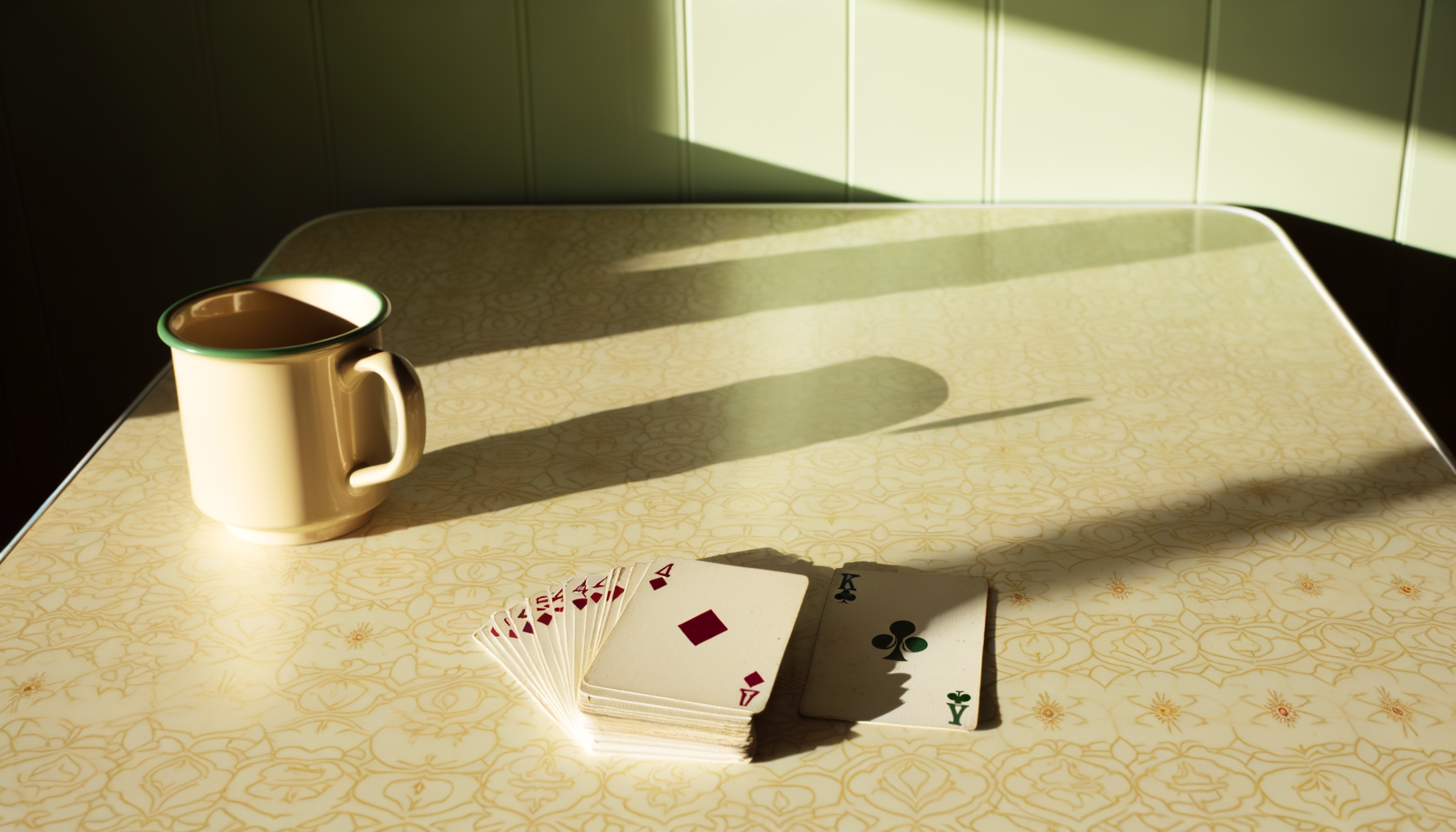
The kitchen smelled like coffee and Old Spice. It was 6:47 in the morning. I know because I checked the microwave clock every few minutes, willing it to move faster so I could watch cartoons. My father sat at the Formica table in his undershirt, a deck of cards spread in front of him in seven neat columns.
“Come here,” he said, not looking up. “I’ll show you something.”
I was eight years old. The cards were slippery and too big for my hands. He didn’t simplify the rules or talk down to me. He just explained: you build down in alternating colors, aces go up top, you’re trying to bring order to chaos. When I asked what happens if you get stuck, he shrugged. “Shuffle and try again. That’s life, kid.”
That was twenty three years ago. My father has been gone for five. I still play solitaire almost every day.
The Inheritance We Don’t Talk About
We speak easily about the things our parents leave behind: houses, jewelry, furniture. The tangible estate. But there’s another inheritance, the one that lives in our hands and our habits. The way you fold towels. The particular rhythm of how you stir your coffee. And sometimes, a game.
Solitaire memories run deep in families. It’s rarely taught formally. There’s no lesson plan, no YouTube tutorial passed from parent to child. Instead, it’s absorbed. You watch someone play while you’re supposed to be doing homework. You ask questions that get half answers because they’re focused on whether to move the seven of diamonds. Eventually, without ceremony, you know the game.
This is how traditions actually transmit: not through instruction, but through presence.
I learned the rules of Klondike at that kitchen table, but what I really learned was that it was okay to sit quietly with another person. That not all time together needs to be filled with conversation. That some mornings, before the world makes its demands, you can just be with someone you love and a deck of cards.
Playing Solitaire Alone: The Paradox of Solitary Connection
Here’s the strange thing about solitaire: it’s a game you play alone that makes you feel less alone.
When I play now, I’m not just killing time or avoiding work (though sometimes I am, let’s be honest). I’m also sitting with my father again, in a way. The cards don’t care that he’s gone. They fall the same way they did in 1997. Red on black, black on red, kings to empty spaces, aces to foundations. The rules haven’t changed. The ritual remains.
Grief counselors talk about “continuing bonds,” the idea that our relationships with the dead don’t end, they transform. We find new ways to stay connected. For some people it’s visiting a grave. For others it’s cooking a recipe. For me, increasingly, it’s solitaire.
There’s a particular quality of attention the game requires. Not intense focus. You can play while your mind wanders. It’s a kind of meditative presence. Your hands know what to do. The patterns reveal themselves. And in that rhythm, in that repetitive motion of flip, consider, move, flip again, something opens up. Space for memory. Space for feeling. Space for the people who taught us to play in the first place.
Comfort Games for Anxiety: Why Solitaire Soothes
I’m not the only one who reaches for cards when life gets hard. In the weeks after my father died, I played hundreds of games. Maybe thousands. I wasn’t trying to win. I barely noticed whether I did. I was trying to survive.
Solitaire works as a comfort game because it gives you just enough to do. Your hands are busy. Your surface mind is occupied with simple decisions. But your deeper mind can process, can grieve, can slowly stitch itself back together without you having to consciously direct it.
Psychologists call this “behavioral activation,” which means engaging in low demand activities that provide structure without overwhelming a system already stressed to capacity. Playing solitaire alone became my version of this. It wasn’t avoidance. It was maintenance. Keeping the engine running until I had fuel again.
The game asks nothing of you emotionally. It doesn’t need you to be okay. It just needs you to flip the next card. And sometimes that’s exactly what you need too.
The History of an Intimate Game
Klondike solitaire has been around since at least the Yukon gold rush of the 1890s. Prospectors played it by candlelight in frozen tents, waiting for spring or fortune or both. The game traveled through generations, through wars and depressions, through the death of kings and the birth of computers.
When Microsoft included solitaire in Windows 3.0 in 1990, they thought they were teaching people how to drag and drop with a mouse. What they actually did was ensure that an entire generation would associate the game with stolen moments at work, with waiting rooms and airports, with any time you needed to be somewhere else in your head for a while.
Now we carry it in our pockets. The cards are pixels. The felt is a screen. But the ritual remains: seven columns, four foundations, the patient work of sorting chaos into order.
If you’ve never played, or if it’s been years, here’s how to play Klondike solitaire. The rules are simple. What the game means to you is between you and the cards.
Why We Keep Playing
My father never explained why he played solitaire every morning. He wasn’t a man who explained things. But I’ve come to understand it anyway.
He worked in a factory where he controlled nothing. The machines ran when they ran. The foreman said what the foreman said. The paycheck arrived on Friday whether you’d done your best work or your worst. But at that kitchen table, at 6:47 in the morning before anyone else was awake, he had a small kingdom of red and black, and he was the only one who could bring it to order.
The game was never about winning. The win rate for Klondike, played correctly without unlimited undos, hovers around 30%. Most games are lost. My father knew this. He played anyway.
Because the point was never the outcome. The point was the playing. The ritual. The daily practice of sitting with uncertainty, making the best moves you can, accepting when the cards don’t fall your way, and shuffling again tomorrow.
That’s what he taught me at that table. Not just the rules. The philosophy.
An Invitation
If you’ve read this far, maybe you have your own solitaire memories. Maybe someone taught you: a parent, a grandparent, a lonely afternoon in a hospital waiting room. Maybe you taught yourself and now you’re the one passing it down.
Or maybe you’ve never played, and you’re curious what all the fuss is about.
Either way, the table is set. The cards are waiting. Play Klondike solitaire. Take your time. There’s no score that matters except the one in your head. Let your mind wander where it needs to go.
And if, while you’re playing, you think of someone you’ve lost, let that happen too. The game has room for it. It always has.
To everyone playing solitaire tonight who’s really just trying to be close to someone who’s gone: we see you. The cards see you. Keep playing.
Frequently Asked Questions
Why do people find solitaire comforting during difficult times?
Solitaire offers what psychologists call “behavioral activation,” a low demand activity that occupies your hands and surface attention while allowing your mind to process difficult emotions. The game’s predictable rules and repetitive nature create a meditative state that many find soothing during anxiety, grief, or stress. Playing solitaire alone provides structure without emotional demands.
Is playing solitaire alone good for mental health?
Research suggests card games like solitaire can support mental health in several ways: they provide cognitive stimulation, create opportunities for mindfulness and flow states, and offer a healthy form of escapism during stressful periods. Many people report using solitaire as a comfort game for anxiety, finding that the simple decision making process helps quiet racing thoughts.
Why do solitaire memories feel so personal?
Unlike most games, solitaire is typically learned through observation and quiet moments with family members rather than formal instruction. These intimate learning conditions, often one on one in unstructured time, create strong emotional associations. The game becomes linked not just to the rules, but to the person who demonstrated them and the atmosphere of those early experiences.
Can playing solitaire help with grief?
Many people find comfort in familiar rituals during grief, and solitaire’s repetitive nature can serve as a form of continuing bonds, maintaining connection with deceased loved ones through shared activities. The game provides something to do with your hands during difficult moments and asks nothing of you emotionally, making it accessible even when more demanding activities feel impossible.
What makes Klondike the most popular solitaire variant?
Klondike’s popularity stems from its perfect balance of simplicity and challenge. It’s easy to learn but offers enough strategic depth to remain engaging. Its inclusion in Microsoft Windows introduced it to billions of users, and its gold rush era history gives it cultural resonance. The game’s meditative rhythm and solitary nature also make it uniquely suited for comfort gaming during difficult times.