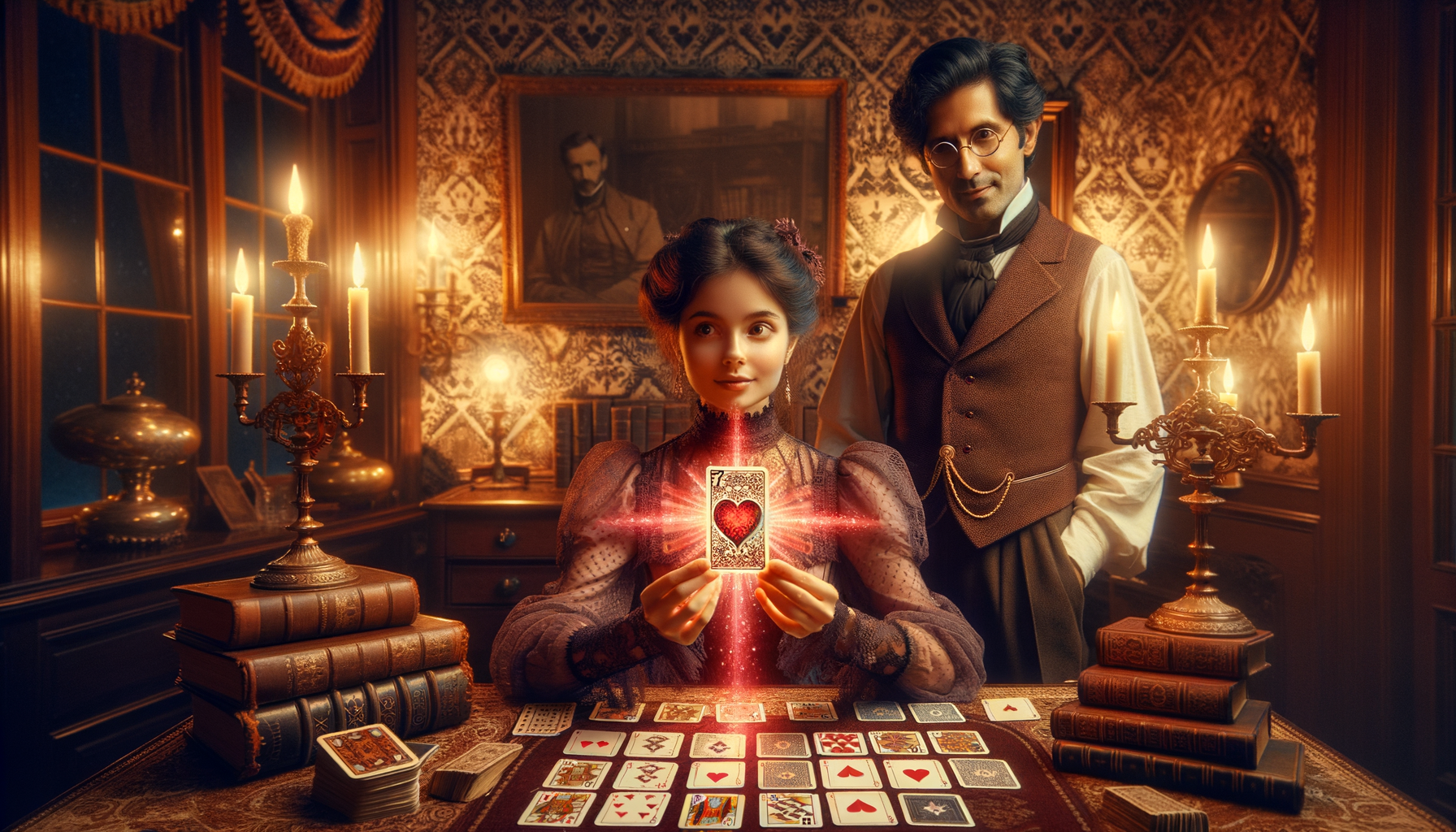
The Cartomancer's Patience: A Victorian Solitaire Tale
In Victorian London, solitaire was more than a card game - it was magic. In certain lamplit windows between midnight and dawn, one might glimpse the phosphorescent glow of enchanted cards, and know that a cartomancer was weaving the threads of destiny through the ancient art of Patience.
The Apprentice’s First Lesson
The year was 1847, and young Eliza Thornwood stood trembling before the mahogany desk of Aldous Pemberton, Master Cartomancer (a wizard who channelled magic through playing cards) of the Worshipful Guild of Playing Card Practitioners. She had come bearing only a letter, found among her late grandmother’s effects, requesting that the Guild assess her potential. The chamber was unlike any she had encountered in her nineteen years, its walls lined not with books, but with glass cases containing packs of cards from every corner of the world.
“You wish to learn the Art,” Master Pemberton said, his voice carrying the weight of decades spent in arcane study. It was not a question.
“Yes, sir,” Eliza replied, her fingers unconsciously reaching toward the pack of cards she kept always in her pocket, a habit her late grandmother had instilled in her since childhood.
The old wizard’s eyes, grey as morning fog upon the Thames, studied her with unsettling intensity. “And what, pray tell, do you believe cartomancy to be?”
Eliza straightened her spine, summoning courage. “The reading of fortunes through cards, sir. Divination.”
Master Pemberton laughed, a sound like shuffling paper. “Fortune telling is for charlatans at country fairs, Miss Thornwood. True cartomancy is something far more profound.” He gestured to the chair opposite his desk. “Sit. I shall show you what the uninitiated call Patience, and what we of the Guild know to be the very language of magical manipulation.”
The Sacred Geometry of Klondike
From within his waistcoat, Master Pemberton produced a pack of cards that seemed, to Eliza’s wondering eyes, to shimmer with an inner luminescence. The backs bore no ordinary pattern, but rather an intricate design of interlocking circles and triangles that hurt to look upon directly.
“Observe,” the Master intoned, and began to lay the cards upon the desk in a formation Eliza recognized immediately.
“Klondike,” she whispered, for she had played this arrangement countless times in her grandmother’s parlour.
“Indeed. Though that name is yet to come. The gold-seekers of a distant frontier will one day call it Klondike solitaire, borrowing this pattern for the luck it brings them.” Master Pemberton’s hands moved with practiced grace, dealing seven columns of cards, each successive pile bearing one more card than the last. “They shall stumble upon a truth without comprehending it. The tableau of Klondike mirrors the seven pillars of magical architecture upon which all enchantment is built.”
Eliza leaned forward, her earlier trepidation forgotten. “I do not understand, sir.”
“Each column represents a different aspect of the magical working,” the Master explained, turning the final card of each pile face-up. “Will. Knowledge. Power. Wisdom. Beauty. Foundation. And Kingdom. These are the seven emanations through which all spellwork must flow.”
The Dance of Suits and Souls
As Master Pemberton played, Eliza noticed something extraordinary. Each card, when moved, left a faint trail of light in its wake: crimson for Hearts, amber for Diamonds, deep violet for Clubs, and midnight blue for Spades.
“The four suits,” the Master continued, drawing a card from the stock pile, “represent the four elements of magical work. Hearts are emotion, the waters of feeling that give spells their purpose. Diamonds are the earth, material manifestation, the physical result of magical labour. Clubs are fire, the transformative force that changes one thing into another. And Spades…” he paused, placing the Ace of Spades upon the first foundation pile, “Spades are air, the intellect, the cutting edge of reason that shapes raw power into refined art.”
The Ace began to glow softly, and Eliza gasped as she felt a subtle shift in the atmosphere of the room, as though a door had opened somewhere, admitting a breath of wind from an impossible distance.
“When we build the foundations,” Master Pemberton said, his voice taking on a reverent tone, “we are constructing the architecture of a spell. Ace to King, each suit must be completed in perfect sequence. This is the discipline of magical work: no shortcuts, no skipped steps. Each card builds upon the last.”
The Test of True Patience
For three hours, Eliza watched as the Master played game after game of Klondike solitaire. Some he won, the cards flowing into their foundation piles with an almost eager willingness. Others ended in stalemate, the remaining cards stubbornly refusing to yield their secrets.
“This is why we call it Patience,” Master Pemberton said at last, gathering the cards together. “Not because the game requires it (though it does) but because patience is the cardinal virtue of the cartomancer. Magic cannot be rushed. It unfolds according to its own rhythm and logic. The wizard who forces a spell is like the player who moves too quickly and traps essential cards beneath immovable obstacles.”
He held the pack out to Eliza. “Your turn, Miss Thornwood.”
Her hands trembled as she accepted the cards. They felt warm, warmer than they ought to have been, and seemed to pulse gently against her palms, like a small creature with a beating heart.
“Do not think of it as a game,” the Master instructed. “Think of it as a conversation. The cards have much to tell you, if you possess the patience to listen.”
The Revelation of the Draw
Eliza dealt the tableau with uncertain fingers, keenly conscious of Master Pemberton’s watchful gaze. The cards fell into their positions, and she turned the final card of each column face-up, and froze.
The Seven of Hearts glowed with soft crimson light.
“Remarkable,” the Master breathed. “You have the Gift, Miss Thornwood. I suspected as much when I sensed your grandmother’s training in you, but this confirms it beyond doubt.”
“What does it mean?” Eliza asked, hardly daring to breathe.
“It means the cards recognize you. They wish to speak with you.” Master Pemberton leaned back in his chair, a smile softening his stern features for the first time. “It took me three years to achieve what you have accomplished in your first attempt. Your grandmother trained you well, even if she never revealed the true nature of what she taught.”
Eliza thought of those long afternoons in her grandmother’s sitting room, the old woman’s patient voice guiding her through game after game of Klondike. Patience, child. The cards will show you the way, if you let them.
She had thought it mere instruction in a parlour game. Now she understood it had been something far greater.
The Path Forward
As the grey light of dawn began to seep through the chamber’s heavy curtains, Master Pemberton rose from his chair and walked to one of the glass cases lining the walls. From within, he withdrew a pack of cards in a worn leather case.
“These belonged to your grandmother,” he said, placing them in Eliza’s hands. “She was one of our finest cartomancers, and she asked me to hold them until her successor was ready.” His grey eyes met hers with profound solemnity. “That successor is you, Miss Thornwood. Will you accept the responsibility?”
Eliza opened the case and drew forth the pack within. The cards were old, their edges soft with decades of use, but they glowed with the same inner light she had seen in the Master’s own pack. Upon each face, she now perceived details invisible to mundane sight: tiny inscriptions in languages she did not recognize, symbols that seemed to shift and dance when viewed from different angles.
“I will,” she said, and the words felt like an oath.
“Then your training begins properly tomorrow,” Master Pemberton said. “But first…” he gestured toward the table, where the cards she had dealt still waited, the Seven of Hearts pulsing with patient light, “finish your game, Miss Thornwood. The cards are waiting for your answer.”
And so began the remarkable career of Eliza Thornwood, who would one day be known as the greatest cartomancer of the Victorian age. But that is a tale for another time.
Perhaps tonight, you might take up a pack of cards yourself, and who knows what secrets they might whisper to one who plays solitaire with true patience. As Eliza’s grandmother knew so well: in Patience, as in life, the victory lies not merely in winning, but in playing with grace, strategy, and an unwavering resolve to begin again.
Play Klondike solitaire now and discover what secrets the cards hold for you.
Frequently Asked Questions
Why is solitaire called “Patience”?
The name “Patience” comes from the virtue required to play the game well. Unlike fast-paced card games, solitaire rewards careful thought and methodical play. The British traditionally called the game Patience, while Americans adopted the term solitaire (meaning “alone”) because it is played solo.
What is Klondike solitaire?
Klondike is the most popular form of solitaire, featuring seven tableau columns with cards dealt in ascending piles. The goal is to build four foundation piles from Ace to King, one for each suit. It became famous during the 1890s Klondike Gold Rush when miners played it to pass time.
Is there skill in solitaire or is it all luck?
While the initial card deal involves luck, skilled players win significantly more often through strategic choices: which cards to move, when to draw from the stock, and how to expose hidden cards. Studies suggest Klondike solitaire is winnable about 80% of the time with perfect play.
What’s the best strategy for winning Klondike solitaire?
Focus on exposing face-down cards in the tableau, prioritize moving Kings to empty columns, and avoid filling empty tableau spaces unless you have a King ready. Building even foundation piles (rather than rushing one suit) also improves your odds.